
Cape Girardeau County Arrest Records and Charges
An arrest record is created by law enforcement. It may show the arresting agency, booking number, booking time, bond, age, custody status, and charge labels used at booking. A court charge record begins when the Prosecuting Attorney, city prosecutor, or another authorized charging authority files a complaint, information, indictment, or ordinance charge with the court. The two records may overlap, but they are not the same file.
The Cape Girardeau County Sheriff's Office operates the local jail and public roster paths. The court charge record is tracked through Case.net, the 32nd Judicial Circuit, the Circuit Clerk, and municipal divisions when the matter is a city case. The full case file and final outcome belong with Cape Girardeau County criminal court records, while the jail roster and custody profile belong with inmate records. This page follows the pathway from arrest to filed charge.
Cape Girardeau County Arrest Records Source
The Cape Girardeau County Sheriff's Office is the practical source for local booking, jail, and detention questions. The Sheriff's Office is separate from the courthouse and operates from the Justice Center in Jackson. Its public site gives the main 24-hour phone line and routes users to inmate, press release, FAQ, contact, and app information.
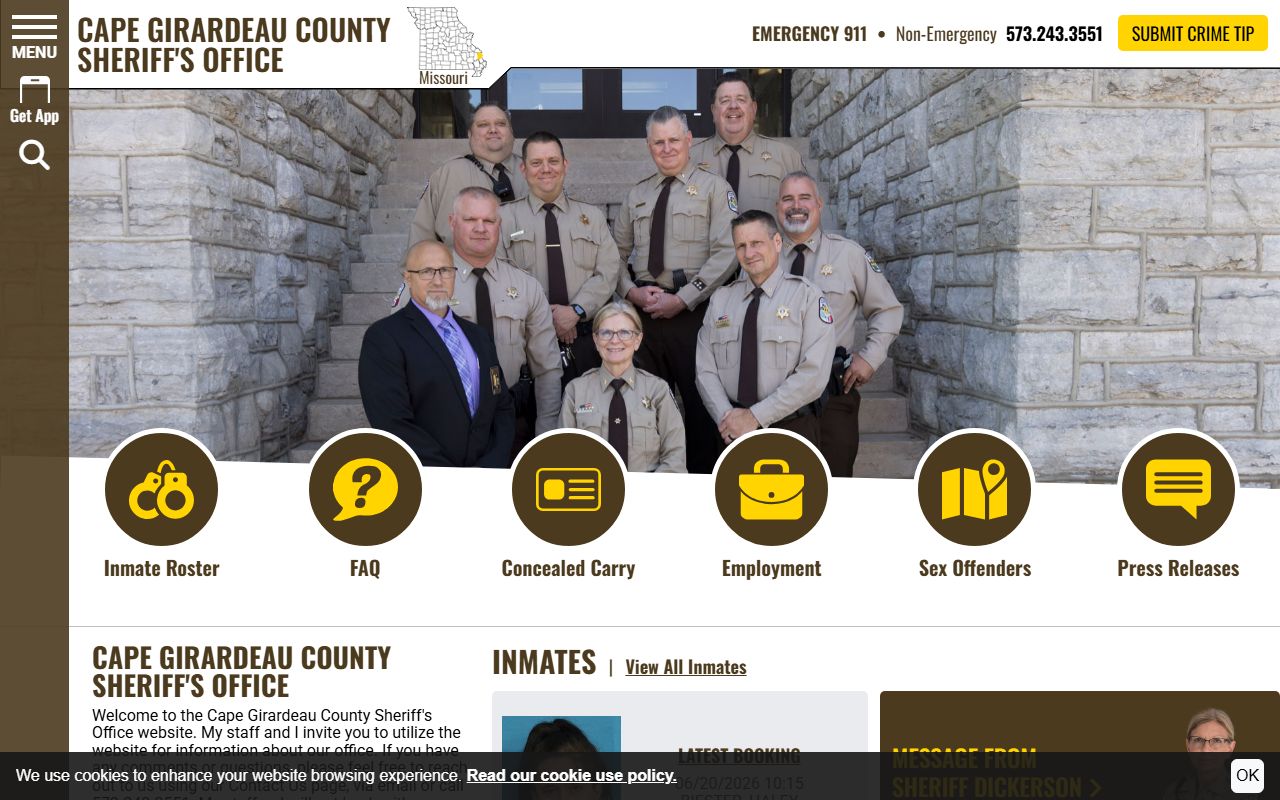
That sheriff source is useful for the arrest side of the record. Once the prosecutor files charges, the court record must also be checked because booking labels and court charges can diverge.
The Sheriff Administration page names Sheriff Ruth Ann Dickerson and lists command staff, jail operations, field operations, business operations, court security, and civil process leadership.
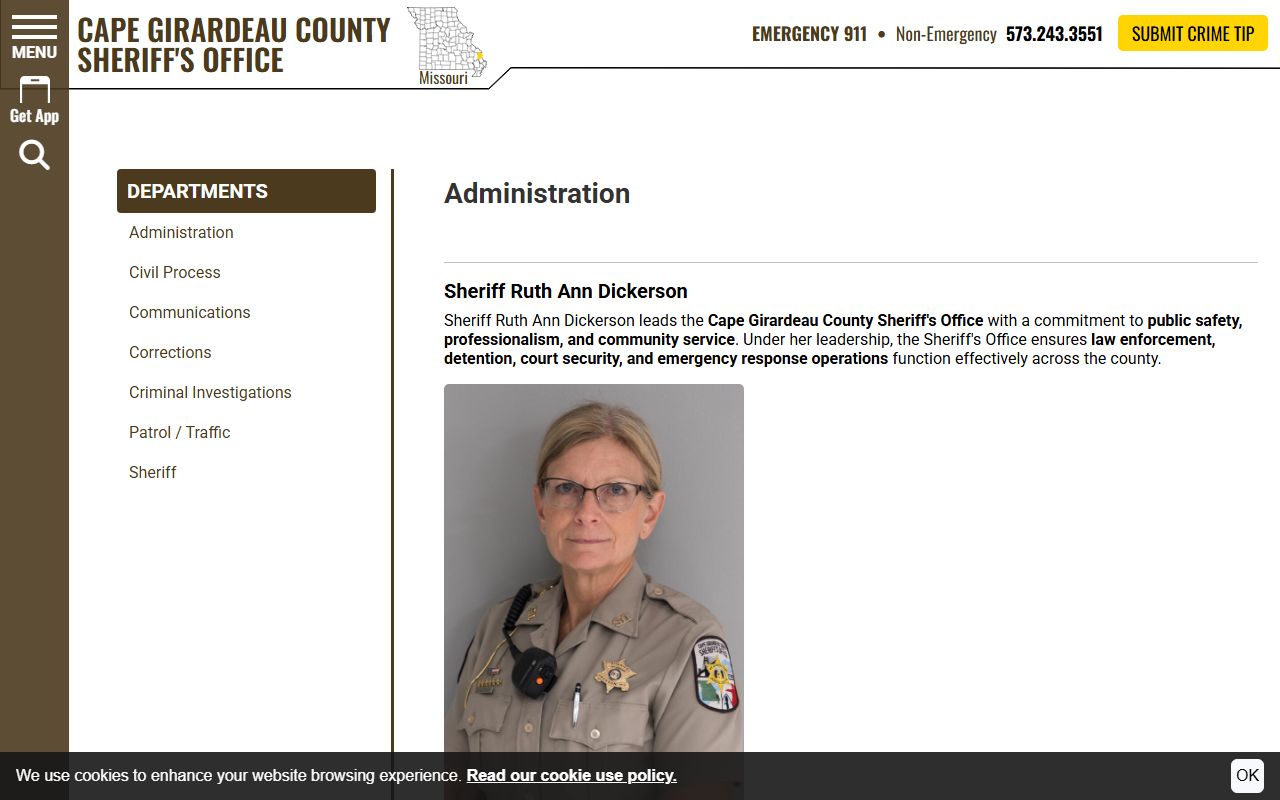
The administration context matters because the Sheriff's Office touches several related records: jail booking, civil process, courthouse security, press releases, and contact channels.
Find Cape Girardeau County Arrest Records
Start with the record type. For jail custody, booking number, bond, arresting agency, and roster status, use the sheriff roster paths. For court charges after arrest, use Case.net and then the Circuit Clerk or municipal court if the online record is incomplete. A person arrested by Cape Girardeau Police Department can be booked into the county jail in Jackson, then charged in the 32nd Judicial Circuit or a municipal division depending on the offense.
- Check the sheriff inmate roster if the question is current custody, recent release, held-elsewhere status, bond, or booking detail.
- Search Case.net by defendant name or case number to see whether formal charges have been filed in court.
- Read each charge line with the docket, because a charge can be amended, reduced, dismissed, or resolved later.
- Use the Circuit Clerk's criminal division or misdemeanor/traffic line for copy questions or current case-number issues.
- Use the municipal court when the charge is a city ordinance or municipal traffic matter.
The sheriff FAQ adds a records timing detail. Police reports are typically available within 5 to 7 business days, but some reports require Prosecuting Attorney approval based on Missouri Sunshine Law before release.
Cape Girardeau Booking and Charge Listings
The current inmate roster is the official sheriff roster path for people currently in the detention center. Roster results can show a photo, full name, booking number, booking date, bond, age, charges, and profile link. A sample profile inspected during research also showed arresting agency, gender, race, and detailed charge codes.
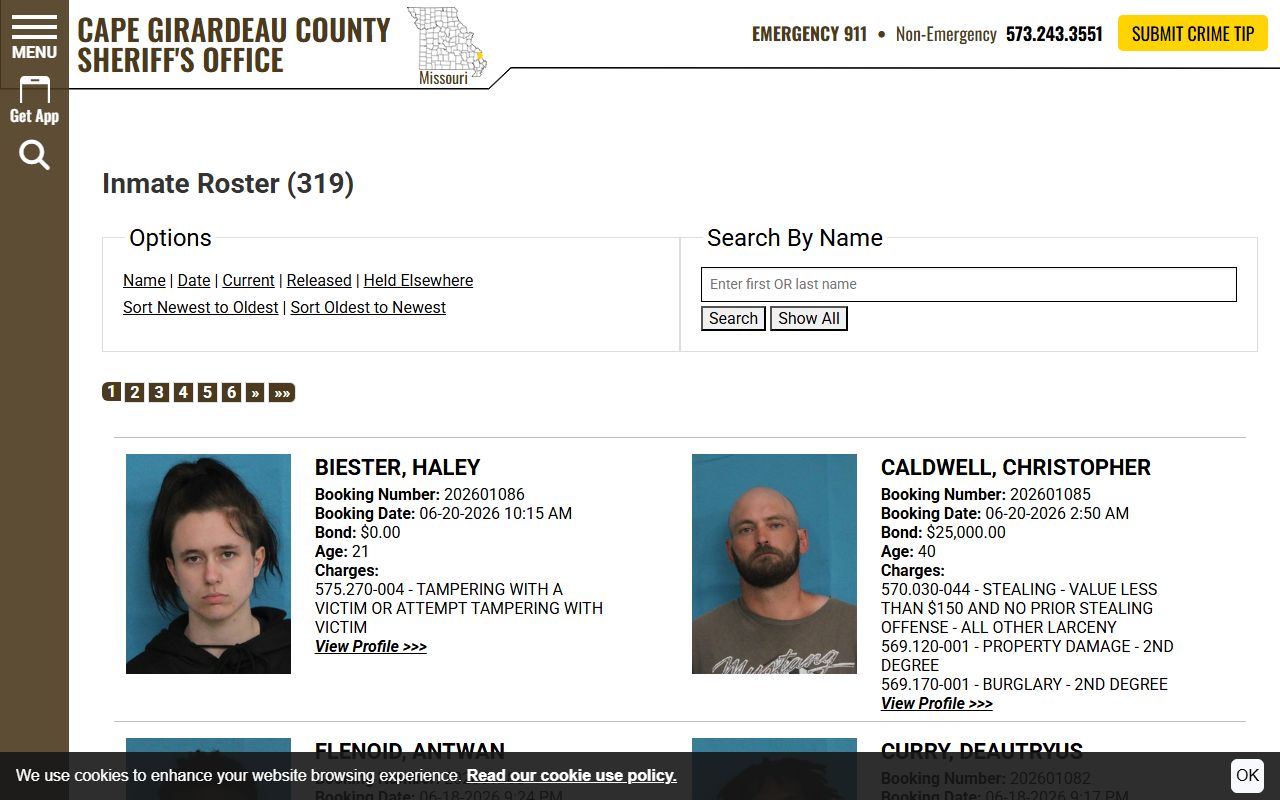
The current roster image is relevant to arrest records because it shows the booking side before or alongside court filings. It should not be read as the final criminal judgment.
The sheriff also maintains a held elsewhere roster for inmates not held at the local detention center.
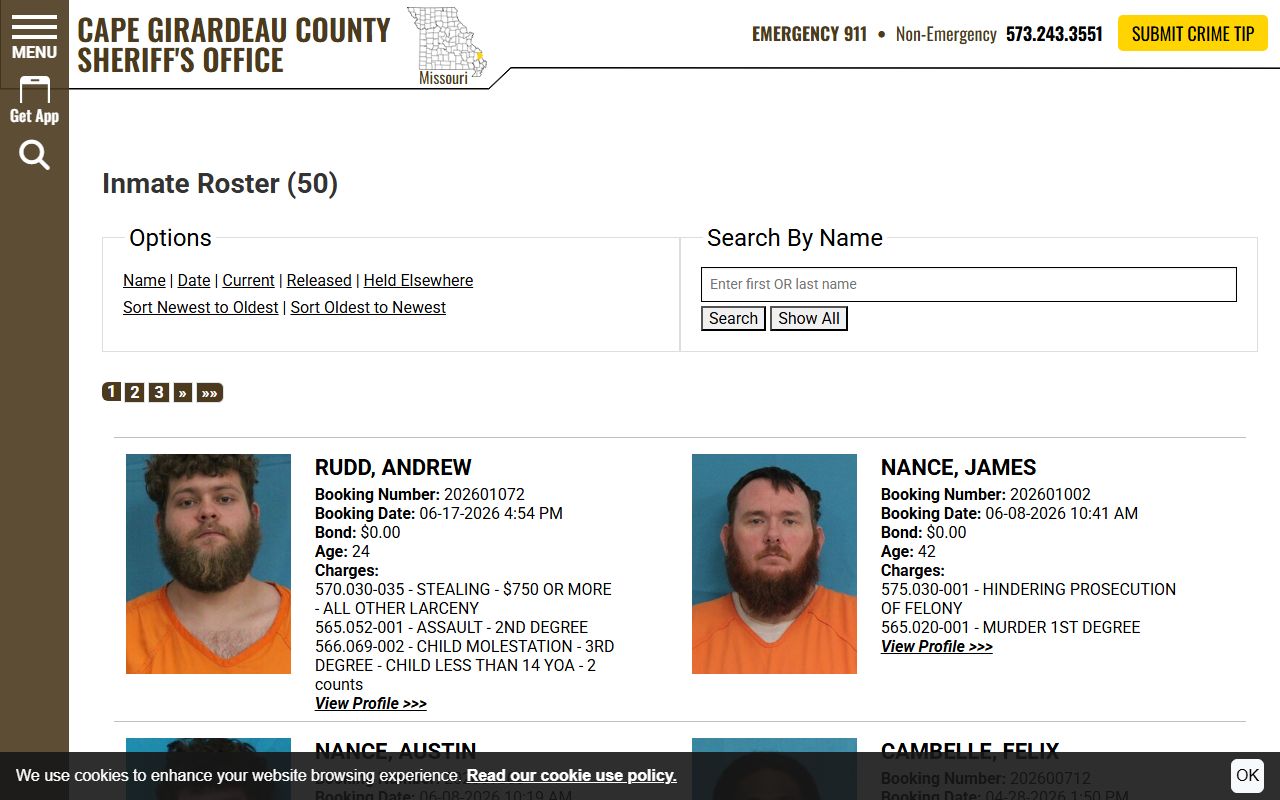
Held-elsewhere status is a local nuance: a person may appear in Cape Girardeau County custody records even when housed outside the county detention center.
Note: Sheriff roster charges and bond amounts can change after court appearances, so confirm current case data with the responsible office.
Charges After Arrest in Cape Girardeau County
Formal charges are filed after law enforcement sends reports to the Prosecuting Attorney or, for municipal ordinance cases, to the city prosecutor. The Cape Girardeau County Prosecuting Attorney decides whether to file felony or misdemeanor charges, amend charges, dismiss charges, negotiate pleas, or proceed to trial. City of Cape Girardeau Municipal Court cases are filed by the City Prosecutor.
| Document | Who Uses It | What It Does |
|---|---|---|
| Complaint | Law enforcement or prosecutor path | States the alleged offense and can start a criminal or ordinance case. |
| Information | Prosecuting Attorney | Formal prosecutor charging document used in many Missouri criminal cases. |
| Indictment | Grand jury path | Formal accusation used when a grand jury returns charges. |
Cape Girardeau Charge Status Terms
A charge is not fixed just because it appeared at booking or on the first court docket. Prosecutors may add counts, amend a statute code, reduce a severity level, dismiss a count, or resolve a count through plea or trial. Reading the docket in date order is the safest way to understand the current charge status.
| Status | What It Means |
|---|---|
| Pending | The charge remains open and has not reached final disposition. |
| Amended | The charge wording, code, count, or severity was changed by later filing or order. |
| Reduced | The charge was lowered to a lesser offense or lower severity level. |
| Dismissed | The court record shows the count or case ended without a conviction on that charge. |
| Nolle Prosequi | The prosecutor declined to continue that charge, if that term appears in the record. |
| Disposed | The charge has a final result, such as guilty plea, conviction, acquittal, or dismissal. |
Cape Girardeau Charges vs Convictions
Arrest records and court charges after arrest can create a misleading picture if a user treats every charge as a conviction. A booking profile can show a charge label before a prosecutor files. A court file can show a charge that later changes. A conviction requires a final guilty plea, finding, or verdict.
| Point | Charge | Conviction |
|---|---|---|
| Meaning | An accusation tied to arrest, booking, prosecutor filing, or municipal filing. | A final guilty result entered by the court. |
| Where It Appears | Sheriff roster, Case.net charge list, complaint, information, or municipal case. | Disposition and sentence entries in the criminal court record. |
| Can Change | Yes, it can be amended, reduced, dropped, or dismissed. | It can be appealed, set aside, or expunged only through lawful process. |
Cape Girardeau Charge Codes
Charge codes connect a charge label to a statute or offense category. The researched sheriff roster examples showed codes such as 570.030-044 for stealing, 569.120-001 for property damage, 569.170-001 for burglary, 577.010-032 for DWI, and 575.150-003 for resisting or interfering with arrest. One arrest can produce more than one charge code.
Codes should be checked against the court case, not only the roster. The court record is where amended counts, dismissed counts, pleas, and sentencing entries appear. If a code is unclear, use the Circuit Clerk for the case record and the Prosecuting Attorney's filing as the formal source of the charge.
Cape Girardeau Arrest Reports and FAQs
The sheriff's FAQ page supplies useful timing and related-record details for arrest and charge research. It states that police reports are typically available within 5 to 7 business days, but some require Prosecuting Attorney approval due to Missouri Sunshine Law. The FAQ also directs sex-offender registry questions to the Missouri State Highway Patrol and provides local registration appointment information.
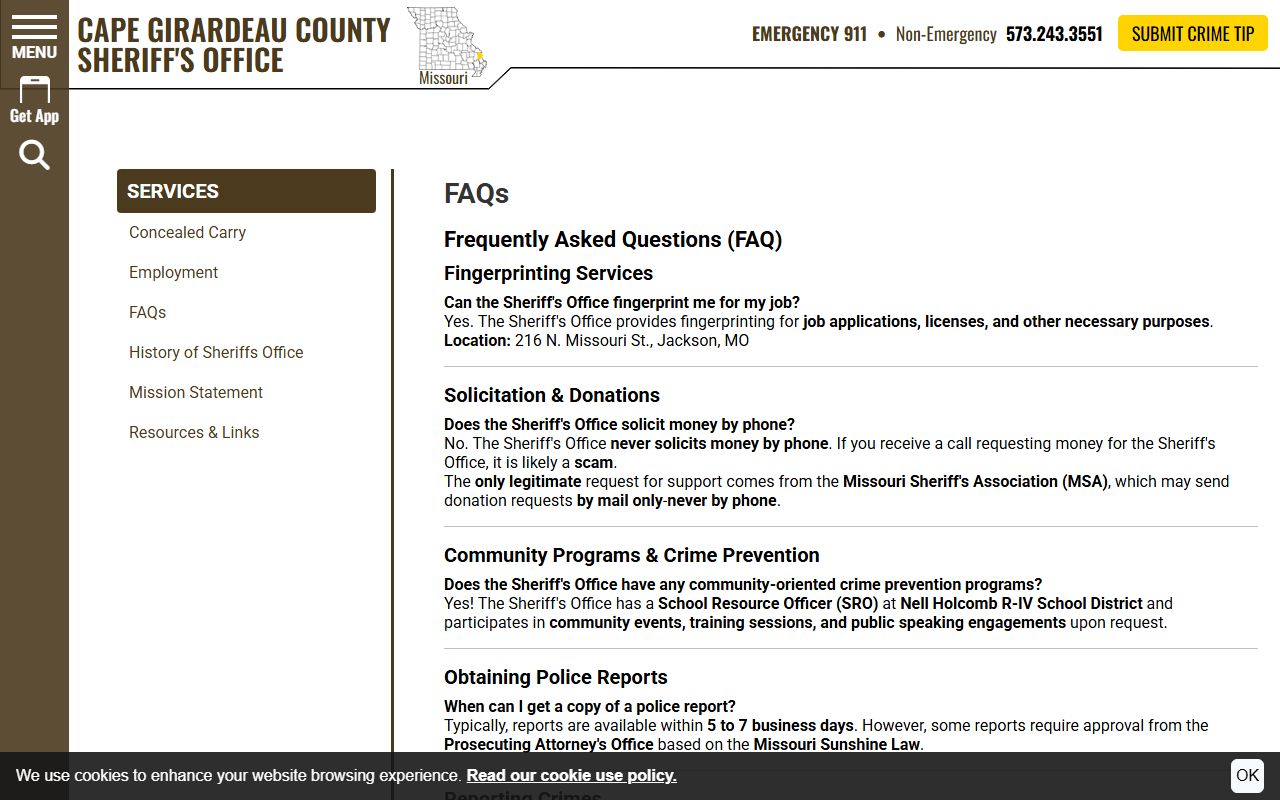
The FAQ is a bridge between arrest records and court charges because it shows why a police report may lag while prosecutor review is pending.
Restricted Cape Girardeau Arrest Records
Missouri law treats law-enforcement records differently from court case files. RSMo 610.100 governs arrest and incident records and when certain law-enforcement records are public or closed. Juvenile records, sealed court files, expunged records, active investigations, confidential victim information, and protected personal identifiers may be withheld.
| Point | Sealed | Expunged |
|---|---|---|
| Public Access | Hidden or limited by court order, law, or rule. | Closed from ordinary public access after qualifying court relief. |
| Record Sources | Can affect court files, law-enforcement files, or both. | Can require agencies to treat covered records under the expungement order. |
| Limits | May still be accessible to courts, parties, or authorized agencies. | Some disclosure exceptions can remain under Missouri law. |
For county-government records outside court files, the County Clerk public-records process is the general fallback. For court charge records, the Circuit Clerk and Case.net remain the court-focused channels.
When a charge is tied to a juvenile matter, domestic case detail, protected victim information, or an active investigation, public access may be narrower than the roster or docket labels suggest. A record can also be public in part and closed in part. For example, the existence of an adult criminal case may be visible while a confidential attachment, personal identifier, or sealed warrant document is not available remotely.
The same caution applies to reports. The sheriff FAQ's 5 to 7 business day report timing does not guarantee release of every report after that period. Prosecutor review, Sunshine Law exceptions, sealed court orders, and ongoing investigation concerns can affect whether an arrest report, incident report, or related file is released.
When the goal is to confirm court charges after arrest, use the most current court source available. A roster entry can help identify the arresting agency, bond, and booking date, but the court record is where the filed count, amended count, dismissal, conviction, or sentence is confirmed.